
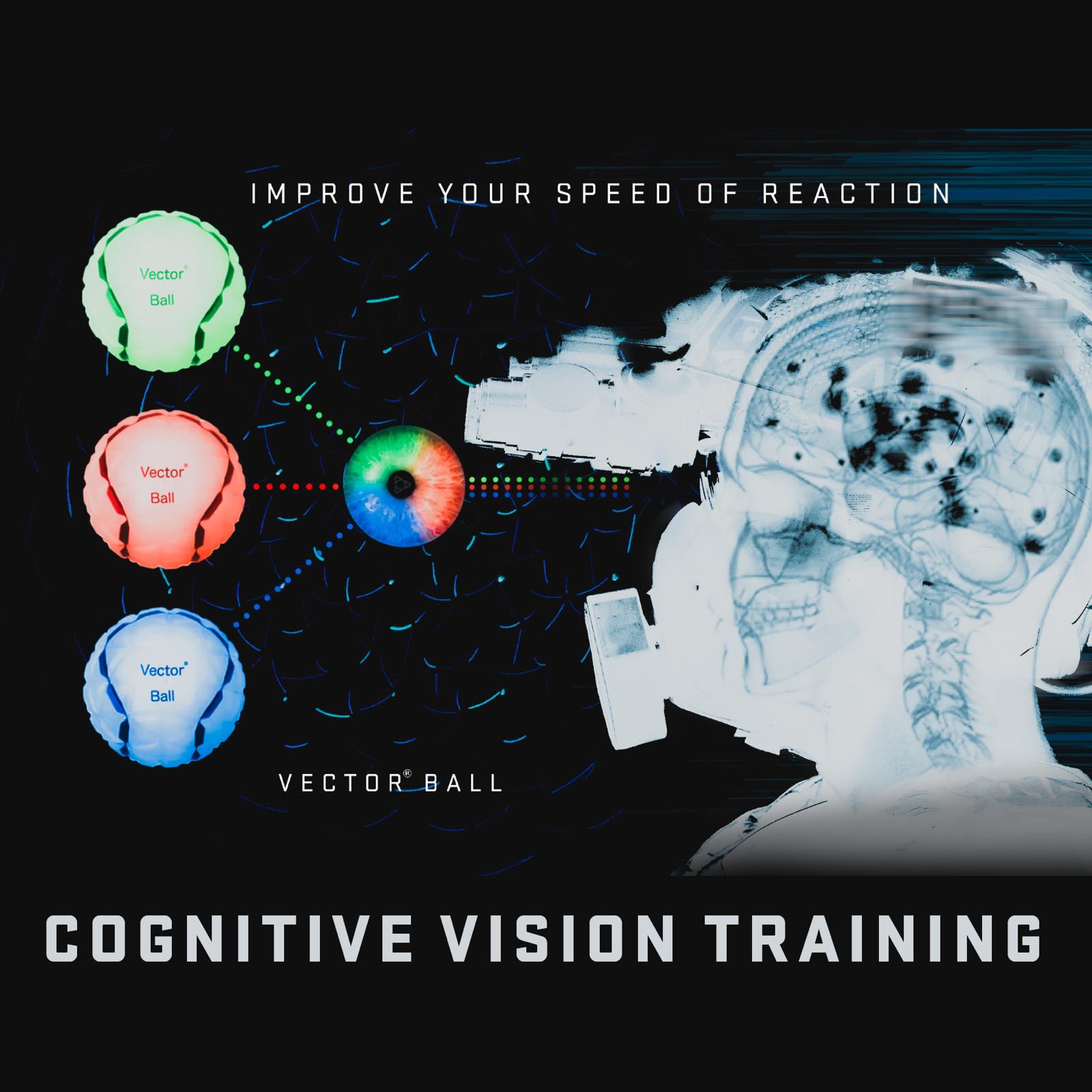
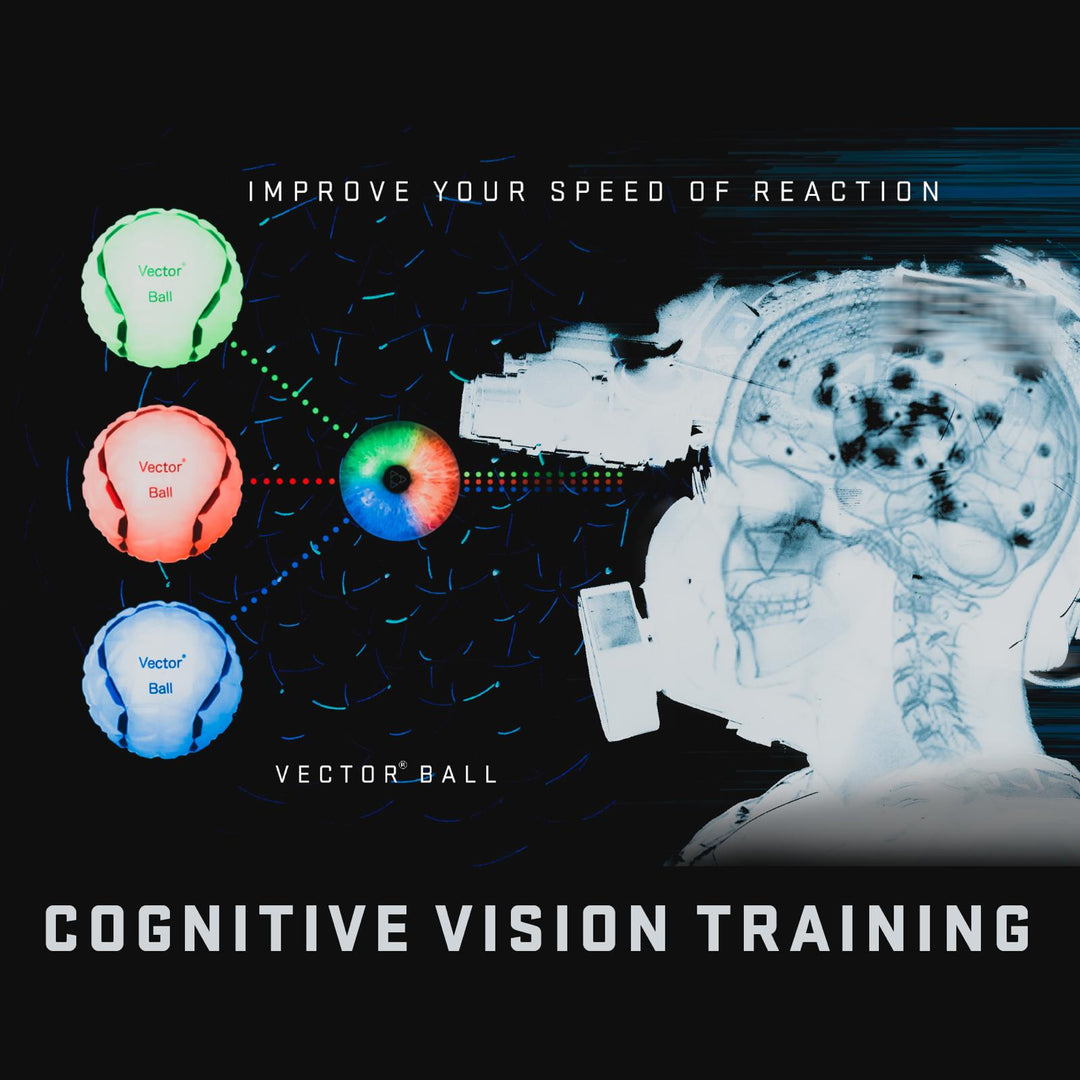
Training with the Vector® Ball engages the brain's executive functions, synchronizing them with body movements. These functions include rapid decision-making, visual information processing, and motor coordination. By introducing unpredictable and complex elements into the exercises, the athlete develops their ability to react quickly and accurately, thus improving their cognitive and physical skills. This helps strengthen the brain-body connection for optimized athletic performance.
Professional competence and vision: the impact of vision on our operational performance
The Vector® Cognitive Performance Quotient assesses an athlete's information processing speed by comparing their performance with and without cognitive elements.
For example, the athlete throws and catches the Vector® Ball against a wall for 60 seconds, then repeats the exercise with color-based instructions. This quotient allows for the measurement of cognitive delays and progress over time. It can also be applied to more complex cognitive exercises, such as working memory.
Cognitive vision training, also called neuro-visual training, is a series of exercises that improves reaction time—that is, the time it takes to respond correctly to visual information. This process includes image recognition, trajectory calculation, and muscle activation in response to perceived information. It incorporates unpredictable data to stimulate the brain to process visual information more efficiently, much like training a muscle. The more the brain is stimulated, the better it becomes.
The Vector® Ball is a cognitive visual training device that changes color randomly (red, green, or blue) with each impact. This unpredictable color variation forces the athlete to react quickly based on the visual information received, such as catching the ball with a specific hand or moving in a particular direction. This stimulates cognitive processing and improves reflexes. The Vector® Ball is considered one of the most versatile tools for cognitive visual training.
It works by emitting a brief pulse of light that randomly changes the ball's color (red, green, or blue) with each impact (bounce, catch, etc.). This random color change provides unpredictable information during exercises, enabling effective visual cognitive training. It is ideal for various neuro-visual exercises and requires no maintenance.
It has no cables, wires, or components that could be lost or damaged. The batteries are high-quality, stable, and non-lithium, ensuring safety. Eye On Ball Inc. offers a one-year warranty on the ball.
The Vector® Ball is designed to provide over 12 months of high-quality, maintenance-free visual cognitive training. Its electronic components are fully encapsulated, making the batteries non-replaceable or non-rechargeable, but they are safe, high-quality, and long-lasting (non-lithium).
Example of CVT (Cognitive Visual Training) exercise:
Wall Drill :
Throw the Vector® Ball against a wall and catch it with the hand corresponding to the color at the moment it hits the wall (green = left hand, red = right hand, blue = both hands). You can personalize the exercise by associating the colors with numbers (red = 1, green = 2, blue = 3) and ask the athlete to perform simple calculations while carrying out the exercise. The goal is to go as fast as the brain allows.

Floor Drill :
Have a partner bounce the Vector® Ball and catch it with the hand corresponding to its color when it hits the ground (green = left hand, red = right hand, blue = two hands). You can add information processing elements, such as having the athlete move toward a cone based on the color of the previous bounce, which improves working memory and agility. The goal remains to be as fast as the brain can react.

Shuttle Drill :
Bounce the Vector® Ball on the floor, and the athlete moves toward the cone corresponding to the color at the moment of impact (green = left cone, red = right cone, blue = center cone). You can customize the exercise by changing the color/cone association or adding information processing elements, such as asking the athlete to move toward several cones after multiple bounces, which improves working memory and agility. The goal is always to make the process as fast as possible for the brain.




Leave a comment