

Breach & Rescue Bar - product overview and field analysis
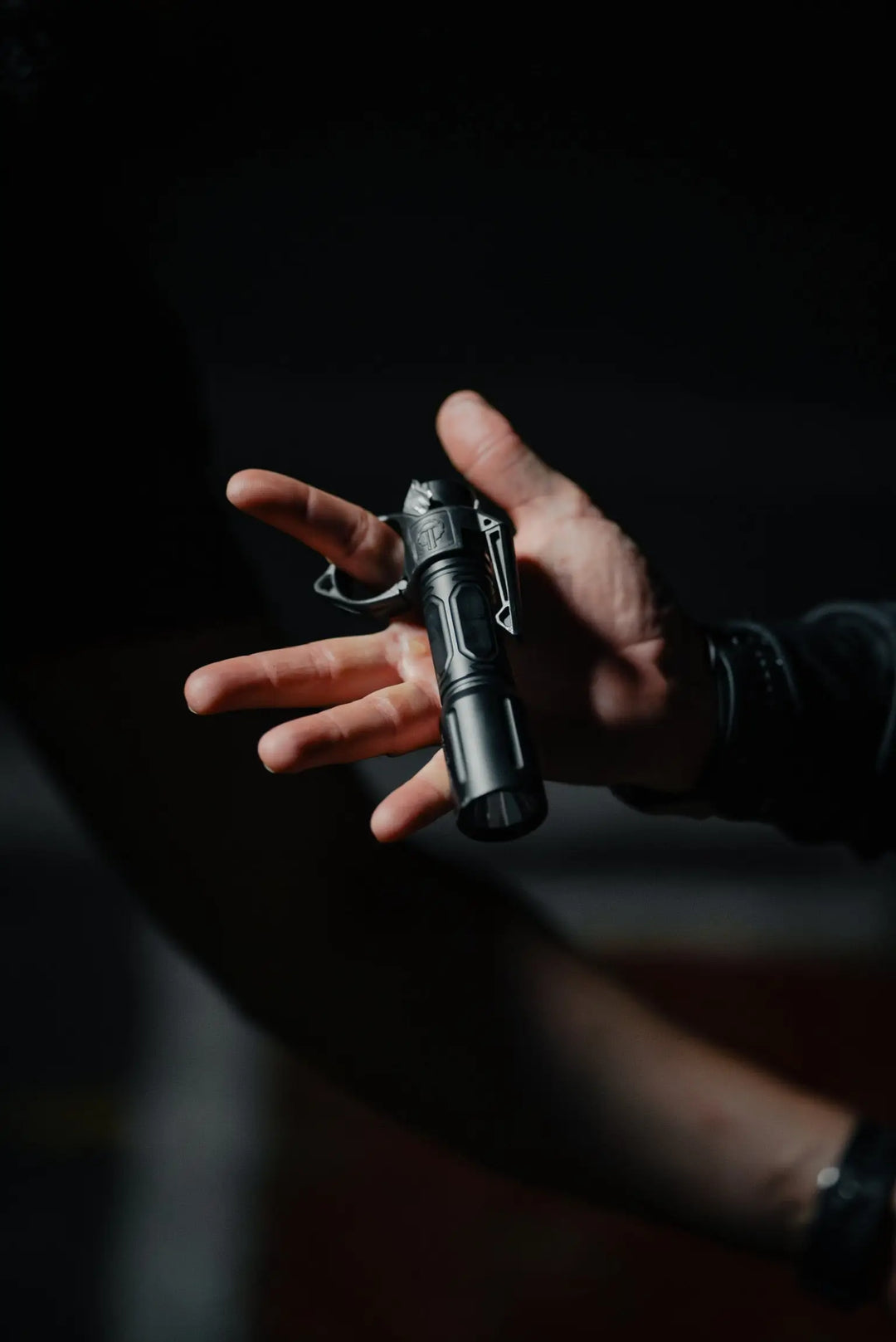
There is a category of tools whose usefulness is only realized at the worst possible moment: those that make the difference between acting and watching. Good Dude Concepts' BRB is one of them. Compact, robust, and designed by active American police officers and first responders, it combines a laminated glass breaker and a pry bar in a single pocket-sized tool. We reviewed the product with its creator, Chris, and we are starting to stock it.

The problem no one saw coming: the widespread use of laminated glass
For decades, breaking a vehicle's side window was simple: a spring-loaded glass breaker, a strike with a ceramic point, sometimes a folded antenna—tempered glass shattered into a thousand pieces and the passage was open. This method no longer works.
In the United States, the FMVSS 226 ("ejection mitigation") federal standard, which came into effect in the mid-2010s, aims to limit the ejection of occupants in the event of a rollover. As a result, on most vehicles above the entry-level range, side windows are now laminated, like windshields have always been.
In practical terms, a thin layer of plastic (PVB) is sandwiched between two sheets of glass. You can shatter the glass, but it stays in place, held by the film. Kicks, sticks, and fists are no longer enough. To open a passage, you must now be able to cut this membrane.
A useful detail: a label in the lower corner of the side window generally indicates whether it is laminated ("laminated"). In Europe, this type of laminated side glazing remains less common today, and classic kinetic glass breakers still work in the majority of cases—but American regulatory changes often precede ours by a few years. Anticipating this change means being ready before others.

The BRB: two functions, one tool
Good Dude Concepts' starting point is simple: pack as much capability as possible into a minimalist format, because no one likes carrying a heavy and bulky tool. The BRB fits in a cargo pocket or slides onto a MOLLE panel on a vest. It is based on two technical signatures:
GlassRipper Profile™ - cutting laminated glass
A series of teeth—about ten—carefully calibrated: aggressive enough to "bite" and cut the plastic film of laminated glass, but not to the point of injuring the person handling the tool with bare hands. The principle is that of a bread knife or a chainsaw chain: the teeth must be in motion to work. The most telling demonstration: during a test, an 11-year-old child cut out an entire rear window. Strength is not everything; it is the technique and the profile of the tool that matter.

BeakPuncture Tip™ - the penetration beak
The beak-shaped tip, weighted by the tool's weight, pierces the glass with a simple flick of the wrist to start the hole—like a glass breaker, but much more versatile. This same beak is strong enough to pry: users use it to open trunks during searches or to rip out a tire valve (immediately immobilizing a vehicle during an arrest, with a driver who has overdosed or is intoxicated).

Technical specifications:
Steel: 420HC stainless steel, corrosion-resistant
Hardness: 50-51 HRC
Coating: Matte black electrodeposition
Cutting profile: GlassRipper Profile™ (teeth for laminated glass)
Tip: BeakPuncture Tip™ (perforation / pry beak)
Angle of the corner: 55° pry bevel, tapered profile
Grip: Textured knurling; holes for paracord wrapping
Weight: 1.25 lb (≈ 567 g) - about the weight of a full AR magazine
Dimensions: 10.5 × 3.75 in (≈ 26.7 × 9.5 cm)
Breakage guarantee: if you break it while using it, the manufacturer will replace it. A deliberate invitation to push it to its limits.

Road rescue: getting someone out of a car
This is the most universal use. Accident, rollover, vehicle on fire or in water, deformed chassis and blocked doors: when the car doors no longer open, the only way out is through the glass. Two techniques are recommended with the BRB:
• Cutting : after starting a hole with the beak, attack the laminate like a steak knife, at about 45° so that all the teeth work. The passage is cut out in a few seconds.
• Scoring: score and weaken the glass along a line before cutting, chaining the breaking points. Useful for lighter profiles, which have less reach or strength.
For side windows, the preferred technique is to attack the base of the window, where the mechanism that holds it is located; once this point is undone, the rest gives way with a push. Good to know: on tempered glass (and even on very tinted glass, which behaves a bit like laminated glass), a sharp blow on a lower corner is usually enough, it is the point, and not brute force, that does the work. The whole thing weighs barely over half a kilo: let the tool do its work.
Important: for vehicle interventions, wearing gloves is highly recommended. The cut glass remains sharp, and the goal is to create an opening through which to extract a person without injuring them further.
The BRB has demonstrated its ability to start even very resistant "hurricane-proof" glass: heating makes the lamination "melt," but it manages to open a large enough breach to pass a hand through and unlock. During a test, the tool even managed to perforate high-security glass reputed to be resistant to the .50 caliber.
Breaching and opening doors: capability in your pocket
The product's genesis is operational. During the response to the Stoneman Douglas (Parkland) shooting, the teams had to park more than a kilometer away, only had a few breaching kits, and the provided passkeys did not work. Hence the idea of a minimalist, individual breaching tool, capable of opening light to medium interior doors, without replacing a hydraulic spreader or a ram, but available immediately, on your person.
The 55° tapered bevel slides into tight door gaps. On an outward-opening door, often a headache to break open with a kick, it is enough to push it into the gap and pry; you can often open it without even breaking the lock, and discreetly. Interior doors give way very easily, nine times out of ten without breaking the latch. For a tighter gap, you can use two BRBs together, one serving as a hammer to drive the other in and create the gap. On locks and even some heavy metal doors with deadbolts, opening remains possible "with technique".
This logic fits a reality of the job: since Uvalde, the doctrine pushes to equip patrols with breaching tools for responding to a mass shooting, but many agencies still do not. For a first responder, a school resource officer (SRO), or a private security guard, having this capability on your person, without waiting for a specialist to bring up the kit from the parking lot, can win the decisive seconds. A real case in Connecticut illustrates this: an responder equipped with a BRB bypassed a barricaded door, broke a window, and rescued a four-year-old child, avoiding a hostage situation.

For whom? From the pro to the everyday driver
Professionals
Intervention teams, law enforcement, military, firefighters, and first responders: a versatile tool that replaces the sharpened flathead screwdriver or the jerry-rigged Craftsman pry bar that many carried for lack of a better option. Discreet breaching before an assault, opening a door during an intervention, immobilizing a vehicle, accessing a trunk: the capability is there, without a hand signal to call a specialist or lost time.
General public and EDC
For civilians, the BRB falls under the same logic as a bleeding kit or a headlamp in the glove box: an item you hope never to use, but whose absence is costly the day you need to extract yourself from a car or provide aid to a trapped motorist. Designed to be intuitive, a few minutes of handling are enough, it is aimed at both a parent who gives it to the whole family and a seasoned operator. We spend most of our lives in a vehicle; few master all critical situations. Here, we do not settle for "hoping to get out by brute force": we really give ourselves a chance.
A philosophy: maximum capability, minimal format, affordable price
Good Dude Concepts' choice is to make the tool affordable so that everyone can have one. The manufacturer's argument is direct: if your service does not buy it for you, one to two hours of overtime is enough. The design favors efficiency and compactness rather than over-engineering: no one-meter handle or teeth as sharp as a firefighter's saw, bulky and dangerous to carry. Just enough, just enough to bite the glass and pry, without injuring yourself.
The range is set to expand: four to five new products are announced for 2026, including a larger version designed for a back panel, with quick-detach (QD) mounts and the ability to connect two tools to gain leverage. The patent filing and prototyping (3D printing) are underway.
Availability
We are stocking the BRB from Good Dude Concepts and making it accessible to our community. Whether you are an operator, first responder, or simply a driver concerned about being ready, it is one of the most versatile tools to emerge in the field in the last twenty years.
Official product sheet: Equip yourself here!
"If you need it and you don't have it, it's the worst day. If you have it and you never need it: all the better."




Leave a comment