
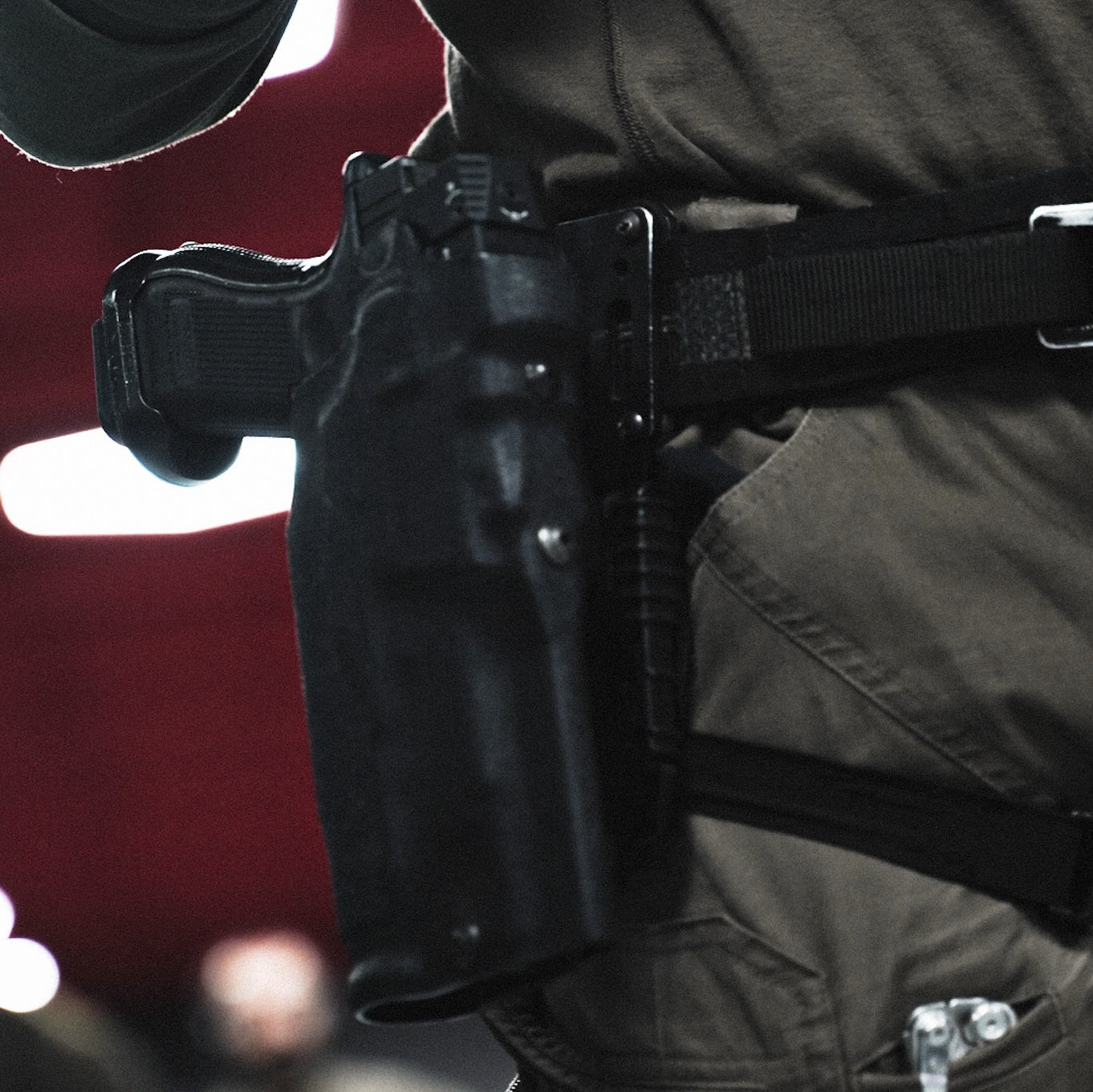

Just over a year ago, we returned from the Centrifuge Training "VCQB Instructor" course with a case in our luggage. Having discovered it during the course, we had a long discussion with William Petty and Blake about their preference for US Duty over Safariland. Both instructors are known for rigorously testing their equipment, choosing only solid, durable, and efficient items that are free of unnecessary features.

Will Petty, as well as the entire Centrifuge team, trust USDG cases.
Due to their primary use within law enforcement, handguns constitute their main platform for defense and combat. When the pistol is not in the user's hands—fortunately, in 99% of cases—it rests in its holster. The importance of this equipment should therefore never be underestimated, as it connects the weapon to its bearer most of the time. Its reliability and design can radically alter the course of events when a lethal intervention becomes necessary, where every tenth of a second counts.
So what makes them so appealing compared to a Safariland? First, they look very similar. For those who wanted a Safariland for its image, you can now benefit from that reputation while owning a robust case.

In summary, US Duty Gear is a relatively new company, born from the desire of a Safariland technical engineer to "do better." Tired of Safariland's disregard for user feedback, he decided to start his own company by investing in a factory vacated by Safariland in California, Ontario.
Another reason for the creation of US Duty Gear lies in the massive relocation of Safariland to Mexico, where the majority of cases are now manufactured (with the exception of the 7TS series).

By leveraging existing teams and production lines, US Duty Gear was able to develop its product line, significantly improving the less-than-perfect aspects of Safariland cases while maintaining exclusively American manufacturing.
In terms of design, it's a single sheet of Kydex folded over itself, but thicker than that used for Safariland's 6000 series (not to mention the fragile 7000 series). A screw, located on the inside of the body, allows for adjustment of the retention on the light or weapon depending on the configuration.

The active retention system (locking on the ejection window) is similar in appearance to Safariland's ALS system, but differs radically in its design.
With the ALS system, the tension of the moving part of the locking system is ensured by a lateral circular spring.
This spring, "protected" by a plastic cap, is a major weak point: the caps are regularly torn off or damaged during adapted movements, and the springs can break as a result of exposure to harsh environments.

Although there are improvement solutions available, I remain skeptical about the need for an addition costing 50 or 60 euros to make the most expensive case on the market more reliable.
On US Duty Gear holsters, the tension is produced by a thick metal blade, fixed to the front rather than the side.

This not only provides increased structural robustness due to its shape, but its positioning also best protects the tension system.

This system aims to lock a movable plastic part, which is removed with the thumb when drawing the weapon, and which locks at the chamber when the weapon is inserted into the holster.
At Safariland, the entire slider is activated during draw. Although functionally similar, excessive compression can break this slider, which represents a MAJOR problem:
- The weapon could not be extracted.
- No locking mechanism when the gun is inserted


Far from being a minor detail, this problem is frequently encountered during VCQB courses, where shooters practice by adopting adapted positions.

Simple and elegant, you'll no longer have to worry about exposed mechanisms like with Safariland models, thus reducing the risk of breakage—at best, the inability to holster the weapon, and at worst, the inability to draw it. Less need for after-sales service and no need to buy additional accessories to protect your systems.
So you have a "Duty proof" product right out of the box.
At US Duty Gear, the thumb lever eliminates the retaining lug, but the entire rider around this system is fixed and noticeably thicker.

Here in green, the stiffener is fixed, thick, and the retention is locked via a lug, which disappears under the action of the thumb.
This last element acts as a reinforcement, significantly improving the case's robustness. All the plastic surrounding the ejection window serves to protect and reinforce the mechanism.

It is even possible to stand on this case or to pass it under the wheel of a car (without a shooter being attached to the case, of course...). 
The weapon's release mechanism in the holster is controlled by a movable lever operated with the thumb. Positioned higher than on Safariland models, it does not compromise your firm and secure grip when drawing the weapon.
It's designed to be wider and features textured grips for improved handling, with or without gloves. Again, there's no need to buy an OT Defense Nub Mod, as is often the case with Safariland users.

The lamp lens cover is removable, so you can take it off if you adopt suitable positions. This prevents a pebble from getting lodged in it and breaking your lens (VCQB tip).

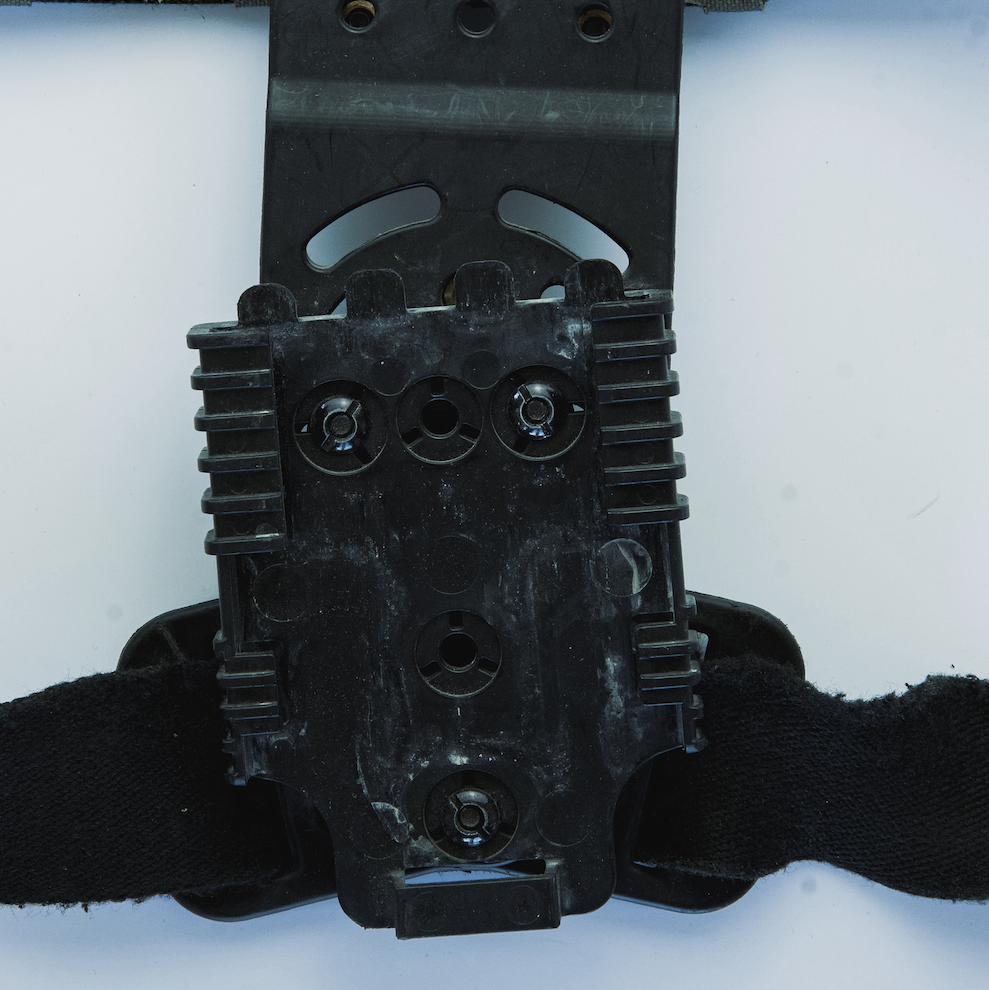
Adopting the same three-hole mounting standard as Safariland, US Duty Gear cases therefore accept all mounting interfaces such as QLS and others.

The most noticeable improvement is in the original angle, as Safariland cases are angled forward right out of the box. While it's possible to straighten them or even tilt them slightly backward, this still requires the addition of extra interfaces like the NCP3 (available here) .

Here the negative angle is clearly visible.

US Duty Gear cases feature a neutral, vertical mounting system that optimizes handling efficiency right out of the box and allows for more effective angle adjustment, whether with a QLS fork, a Wilder Tactical offset, or an NCP3 if necessary.

Several optical cutouts are available: open optics with a kydex cutout, or closed optics with the kydex going all the way up to protect your open transmitters (until you opt for a closed-case transmitter, see Steve's review of the PANDORA ).

The cases are available in nearly 17,000 models. Feel free to contact us by email or phone for any specific requests!
Available in our shop for GLOCK 17/19/45 Gen 1 to 5 models, in left-handed and right-handed versions, with or without optics, open or closed, in the following colors: Black - Coyote - Multicam Original - Multicam Black - Multicam Tropic

Supplied with an offset equivalent to the Mid Ride, they are compatible with Safariland QLS. This kit, combined for example with a Wilder Tactical offset, offers you a high-end setup. It's a "Good to Go" option and is currently our preferred configuration.
Find all US Duty Gear models here!
Article by Zach & Clement
Coming soon to SIG 2022? Subscribe to the newsletter to stay informed!



Leave a comment